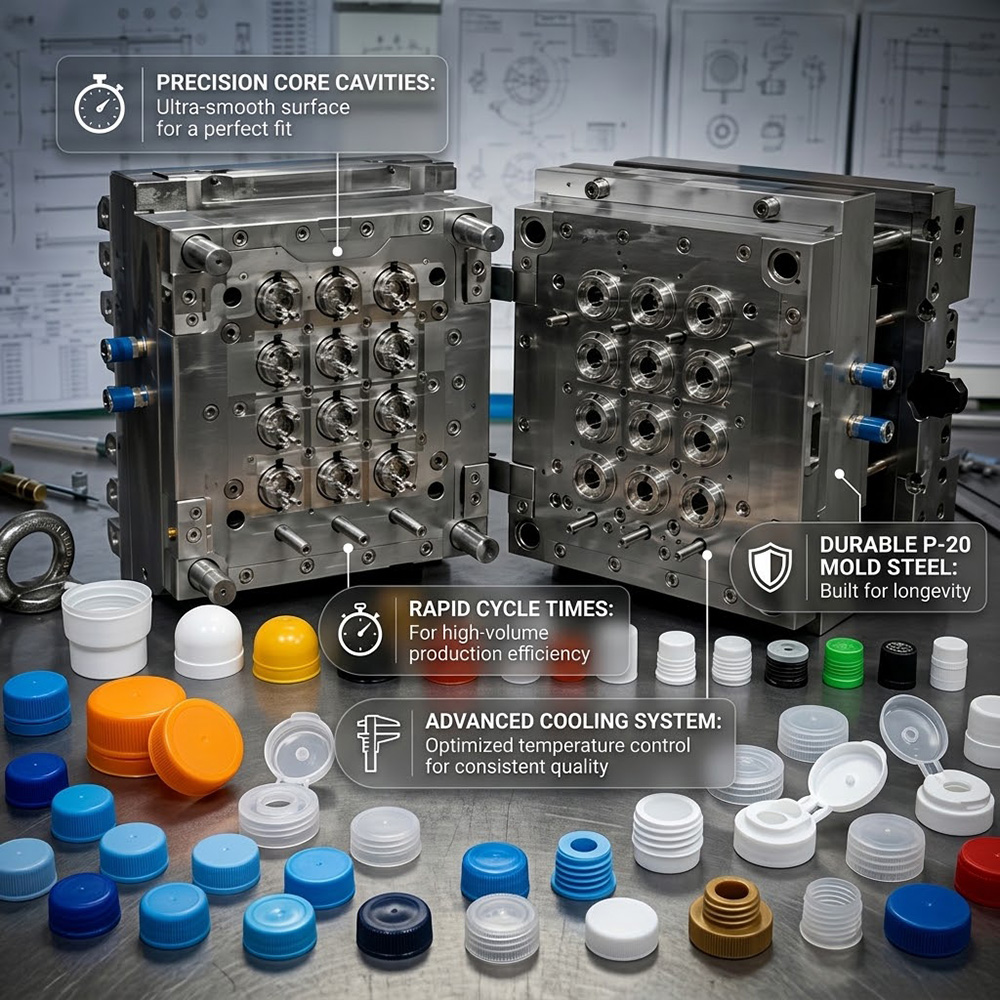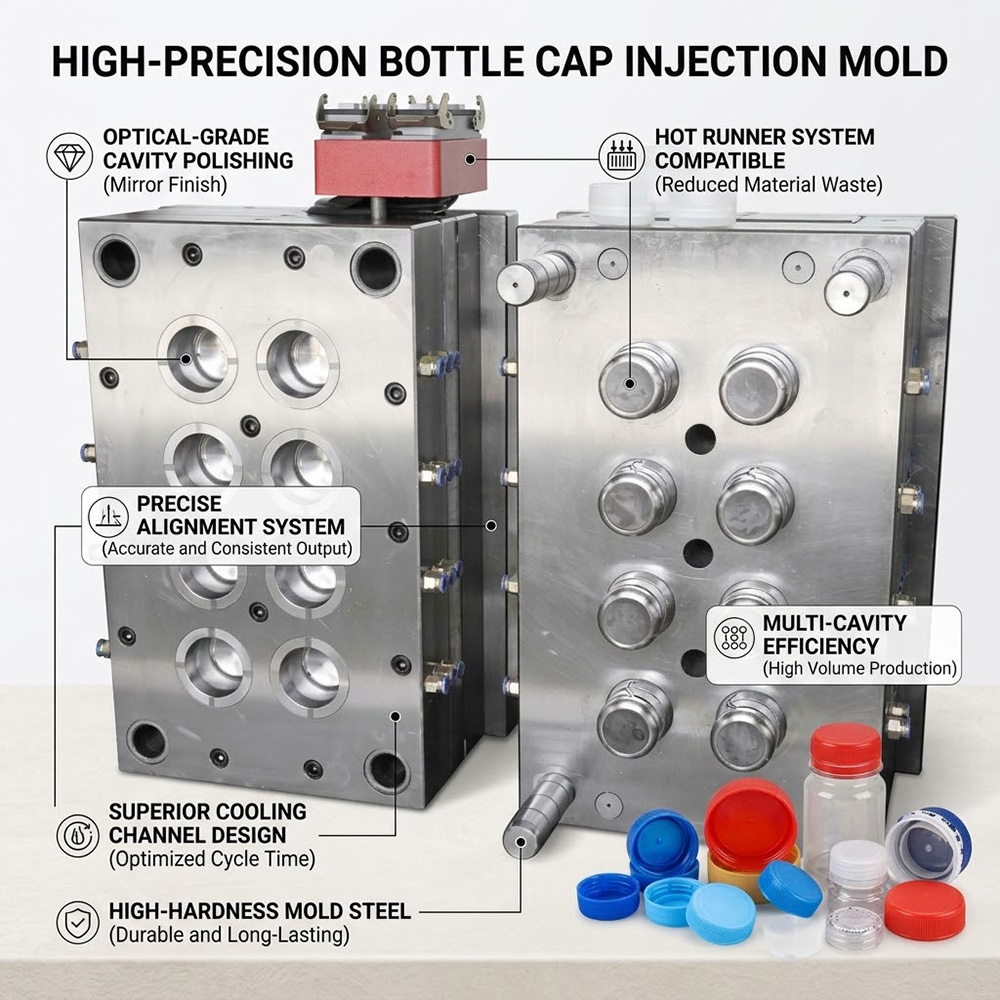
How to Design High-Cavity Cap Molds: From 8 Cavities to 64 Cavities
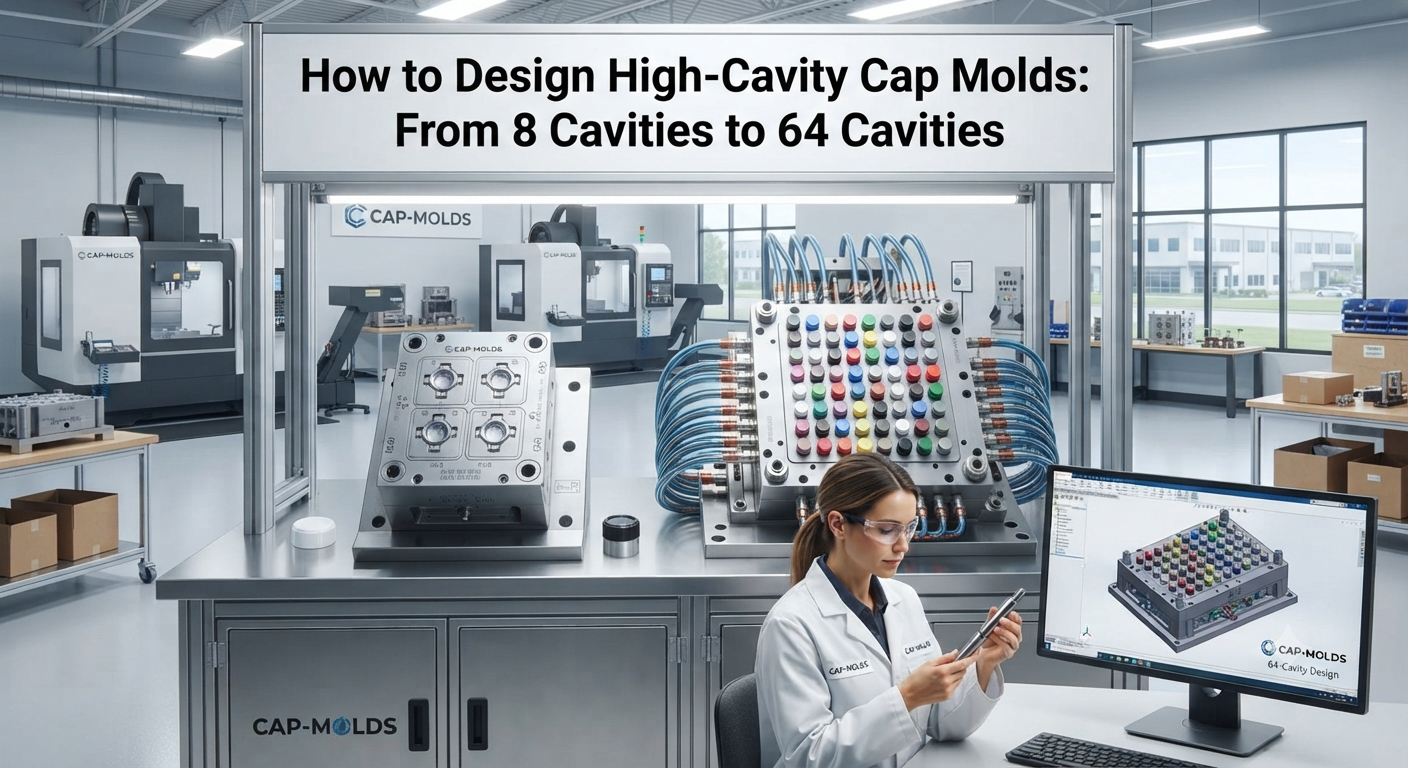
How to Design High-Cavity Cap Molds: From 8 Cavities to 64 Cavities
In the competitive realm of high-speed plastic packaging, scaling production capacity from a low-volume pilot line to an ultra-efficient mass-manufacturing operation is a defining milestone. Whether scaling up from 8 cavities to 16, 32, or a massive 64-cavity system, transitioning into high-cavity cap molds requires an uncompromising commitment to precision engineering, thermal equilibrium, and mechanical synchronization.
As a leading Chinese engineering and manufacturing specialist in advanced closure tooling, .cap-molds delivers bespoke, turnkey mold solutions designed to withstand millions of high-speed cycles. In this technical whitepaper, our engineering team explores the critical architectural, thermal, and mechanical variables involved in designing high-cavity bottle cap molds that maximize output while minimizing unit production costs (COGS).
1. The Scaling Spectrum: Selecting the Right Cavitation Tier
Scaling up cavitation is not a simple linear replication of a single cavity; it is a fundamental shift in mold dynamics. When designing a high-efficiency closure tool, cavitation must align perfectly with your annual volume targets and injection molding machinery specifications:
- 8 to 16 Cavities: Ideal for specialized, thick-walled dispensing closures, low-volume regional runs, or sampling phases where mechanical complexity (such as multi-slide actions or intricate living hinges) takes precedence over raw volume.
- 32 Cavities: The sweet spot for mid-to-high capacity personal care and cosmetic caps, balancing flexible changeovers with robust daily output.
- 64 Cavities and Above: The gold standard for mass-volume beverage, water, and CSD (carbonated soft drink) caps. These molds demand extreme machining accuracy, advanced hot runner integration, and robust high-speed machine compatibility.
2. Melt Balance and Manifold Engineering in High-Cavity Systems
The single greatest challenge in a 32 or 64-cavity mold is ensuring that molten polymer reaches every single cavity simultaneously, at the exact same temperature and pressure.
- Naturally Balanced Hot Runner Manifolds: To prevent localized degradation and short shots, .cap-molds utilizes custom-engineered, naturally balanced hot runner systems (partnering with global industry leaders like Husky, Yudo, and Mastip). Every flow path from the machine nozzle to the individual gate features identical runner length and diameter ratios.
- Thermal Isolation: Precision heater bands and independent thermocouple zones are integrated directly into the manifold plate to eliminate thermal gradients across the expansive mold base.
3. Advanced Thermal Management: Conformal Cooling & BeCu Inserts
In high-cavity production, cycle time is measured in fractions of a second. However, squeezing out faster cycles increases thermal accumulation, leading to out-of-roundness (elliptical deformation) and cooling warp.
- Beryllium Copper (BeCu) Integration: We place high-conductivity BeCu inserts strategically in core tips and thread zones. BeCu conducts heat up to 4 times faster than standard tool steel, instantly eliminating residual heat from dense thread sections.
- Conformal Cooling Circuits: By leveraging state-of-the-art 3D metal printing (Selective Laser Melting) for core inserts, we create fluid cooling channels that spiral along the exact contours of the cap, ensuring uniform heat extraction and keeping cycle times strictly under 7 seconds.
4. Mechanical Precision: Interchangeability and Tolerances
When a mold houses 64 cavities, maintenance downtime can cripple overall plant efficiency. If a single core is damaged, the tooling must not require custom hand-fitting.
Operating state-of-the-art Japanese and Swiss CNC machinery (Makino, Yasda, and AgieCharmilles), .cap-molds guarantees absolute cavity-to-cavity interchangeability within a strict tolerance window of ±0.005mm. Furthermore, all core and cavity inserts are crafted from premium Swedish S136 stainless steel (hardened to HRC 48–52), offering exceptional corrosion resistance against damp cooling water and superior wear resistance over millions of cycles.
5. Technical Comparison: Low-Cavity vs. High-Cavity Mold Architecture
| Design Parameter | 8 to 16 Cavity Mold | 32 to 64+ Cavity Mold |
|---|---|---|
| Target Application | Specialty closures, thick-walled jars, pilot runs | Mass-volume water, CSD, and beverage caps |
| Runner Configuration | Cold runner or simplified semi-hot runner | Fully balanced, valve-gated hot runner system |
| Cooling Efficiency | Standard drilled straight-line cooling channels | 3D conformal cooling combined with BeCu inserts |
| Maintenance Downtime | Low complexity, occasional manual tuning | Modular drop-in interchangeable inserts for rapid servicing |
Partner with .cap-molds for Your Next Scaling Project
Designing and manufacturing high-cavity bottle cap molds requires deep industry expertise, advanced machinery, and rigorous DFM validation. As a premier Chinese cap mold manufacturer, .cap-molds bridges the gap between high-end Swiss engineering precision and cost-effective manufacturing.
Ready to scale your production capacity and maximize your return on investment? Contact the technical experts at .cap-molds today to review your cap design drawings and request a comprehensive engineering proposal.
Keywords: high cavitation mold, 64 cavity cap mold, 32 cavity mold, bottle cap mold, cap mold design, .cap-molds, China cap mold manufacturer, hot runner cap mold, injection molding cap, conformal cooling mold, plastic closure tooling, S136 mold steel, high speed cap mold, cap tooling expert