High-Cavity Tethered Cap Molds: Maintaining 48-Cavity Production Efficiency with Complex Side-Action Mechanisms
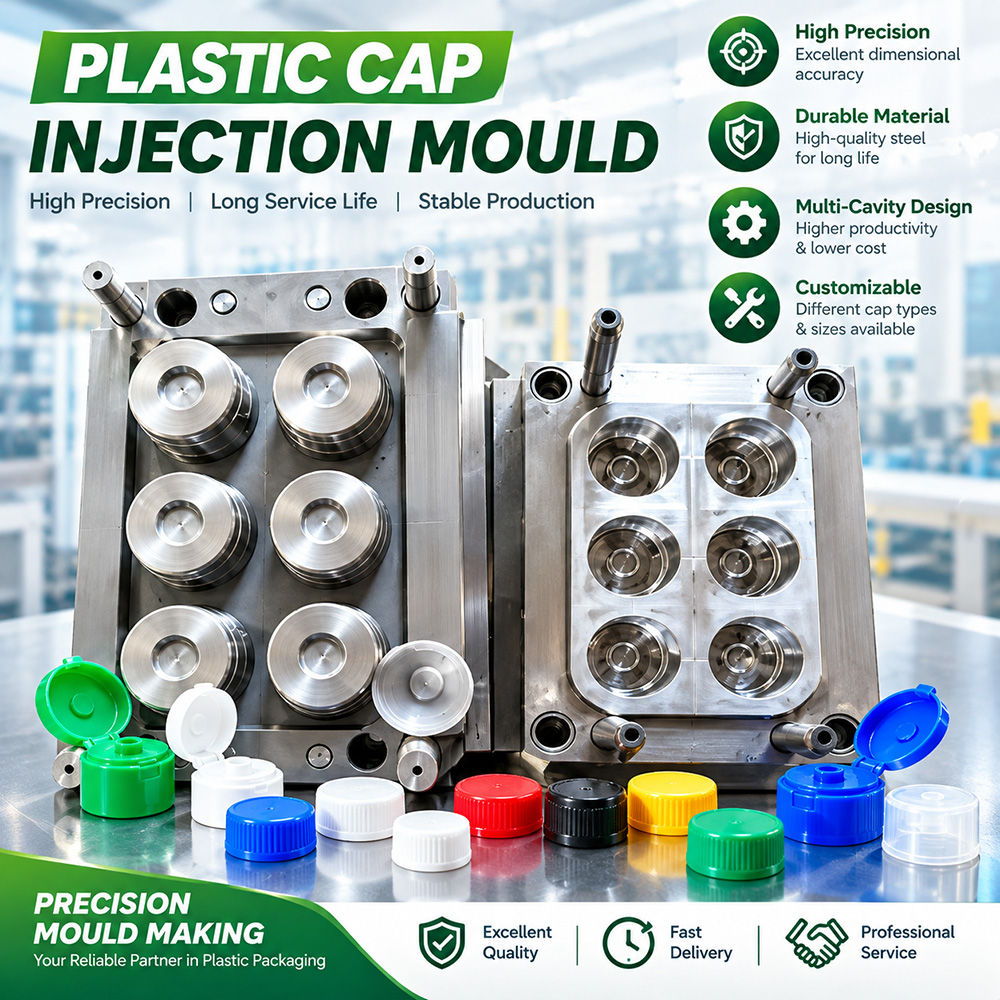
High-Cavity Tethered Cap Molds: Maintaining 48-Cavity Production Efficiency with Complex Side-Action Mechanisms
Published by cap-molds — Technical Whitepaper & Engineering Guide
Introduction: The High-Cavitation Challenge in Tethered Closure Tooling
Driven by sustainability mandates such as the European Union Single-Use Plastics (SUP) Directive (Directive EU 2019/904) and standard EN 17665:2022, global beverage brands and rigid packaging converters are transitioning their production lines to tethered closures. While single- or low-cavity prototype tools easily replicate complex hinge geometry, scaling up to a 48-cavity or 64-cavity tethered cap mold creates significant mechanical and thermal challenges.
Incorporating functional hinges, retention bands, and undercut latches into high-cavitation tooling requires complex side-action mechanisms, mechanical lifters, or hydraulic unscrewing cores. Without precise mold kinematics and optimized thermal management, side-action mechanisms increase mold stack dimensions, add mechanical wear points, and prolong total cycle time. As a specialized China bottle cap mold manufacturer, cap-molds engineers advanced 48-cavity tethered cap tools that maintain ultra-fast cycle times under 6 seconds while delivering absolute multi-cavity component interchangeability.
1. Kinematic Synchronization of Side-Action & Lifter Mechanisms
Forming complex tether joints and living hinges requires side-action slides or early-return mechanical lifters to actuate prior to mold platen separation or stripper plate ejection. In a 48-cavity mold layout, synchronizing dozens of moving components within a tight mold base footprint is essential to prevent slide collisions and pin galling.
Core Kinematic Engineering Principles:
- Guided Mechanical Slide Drives: Utilizing self-lubricating angled guide pins combined with hardened wedge lock blocks (HRC 58–60) guarantees tight shut-off zero-clearance sealing, eliminating flash formation across living hinge webs.
- Integrated Early-Return Systems: Mechanical latch locks and pneumatic safety interlocks verify that all 48 side-action slides are fully retracted before core ejection begins, preventing catastrophic tool crash events.
- Compact Cavity Spacing: Direct-actuated side cores allow tight center-to-center cavity pitch, enabling a 48-cavity layout to fit inside standard 300T to 400T high-speed injection molding machines (IMMs).
2. Thermal Balance and Conformal Cooling Optimization
In high-cavitation closure molding, cooling accounts for more than 60% of total cycle time. The addition of side-action mechanisms complicates standard straight-drilled cooling line routes, leaving thermal hotspots around the hinge area and thread cores.
| Tooling Component | Standard Design Limitations | cap-molds Conformal Solution | Performance Impact |
|---|---|---|---|
| Core Pin & Thread Insert | Straight cooling baffles leave static heat pockets in core tips | 3D SLM printed metal inserts with spiraled conformal cooling channels | Unseated core heat dissipation; 22% reduction in cooling phase |
| Slide Core (Hinge Area) | Uncooled solid steel sliders cause uneven plastic shrinkage | Direct internal water channels routed into moving slide bodies | Prevents hinge warpage; ensures precise opening angles (>120°) |
| Cavity Plate | Peripheral cooling loops yield temperature gradients across outer cavities | Balanced multi-circuit manifold cooling with independent flow monitoring | Cavity-to-cavity wall thickness variation kept within ±0.02 mm |
3. Steel Metallurgy and Tribological Coatings for Ultra-High Service Life
Continuous operation of a 48-cavity tethered cap mold under high injection pressures generates extreme mechanical stress on moving slide faces, guide pins, and shut-off edges. At cap-molds, we enforce rigorous metallurgical selection to guarantee a minimum mold life of 5 million cycles.
- Stainless Steel Cavity & Core Inserts: Premium Swedish ESR-grade S136 / Assab 8407 stainless steels, hardened to HRC 50–54, offer superior corrosion resistance against additive masterbatches and maintain mirror polish.
- Beryllium Copper (BeCu) Inserts: High-conductivity BeCu alloys positioned in deep thread zones accelerate heat transfer away from heavy wall sections.
- DLC (Diamond-Like Carbon) Coatings: Physical Vapor Deposition (PVD) applied to side-action slides and core pins reduces friction coefficients below 0.1, enabling dry-lube operation suitable for cleanroom beverage and food packaging.
4. Valve-Gated Hot Runner Balancing and Rheological Control
Filling 48 individual cavities through delicate micro-gates without thermal degradation requires a fully balanced hot runner manifold. Micro-injection balance ensures that delicate tether straps fill simultaneously without short shots or flash.
- Individual Zone Temperature Control: Thermally isolated hot runner nozzles feature independent PID control loops to maintain melt temperatures within ±1°C across all 48 gates.
- Pneumatic/Hydraulic Valve-Gating: Valve stem actuation eliminates gate vestige, ensuring smooth cap top surfaces and preventing stringing during high-speed ejection.
- Moldflow Fill Balance: Rheological simulations verify shear rates across thin hinge sections (0.25 mm to 0.35 mm thickness), aligning polymer chains to maximize flexural fatigue resistance under repeated bending.
5. Quality Control, Inter-Cavity Interchangeability, and FAT Validation
To eliminate production downtime caused by component wear, cap-molds manufactures all 48 cavity inserts, cores, and slide modules to sub-micron machining tolerances. This guarantees 100% plug-and-play component interchangeability without manual fitting.
Factory Acceptance Testing (FAT) Protocol:
- High-Speed 4-Hour Trial Run: Continuous dry and wet production runs on high-speed IMMs to verify total cycle time (< 6.0 seconds) and automatic drop functionality.
- Automated Optical CMM Inspection: Complete dimensional evaluation of samples from all 48 cavities, verifying thread profile, seal lip geometry, and tether band dimensions.
- Mechanical & Performance Testing: Tensile pull testing (>25 N retention force as per EN 17665), closure opening angle verification, drop testing, and pressure seal leak testing under carbonated beverage conditions.
Why Partner with cap-molds for High-Cavitation Tethered Cap Solutions?
At cap-molds, we specialize exclusively in high-efficiency, multi-cavity plastic bottle cap molds designed for global beverage, dairy, and consumer product manufacturers. Our engineering team combines advanced DFM analysis, precision German and Japanese CNC tooling, and state-of-the-art hot runner design to maximize output while lowering cost-per-part.
By solving the mechanical complexities of 48-cavity side-action tooling, we empower converters to achieve full EU SUP regulatory compliance without sacrificing plant productivity or operational efficiency.