Case Study: Reducing Warpage in Thin-Wall Caps Through Process Parameter Optimization
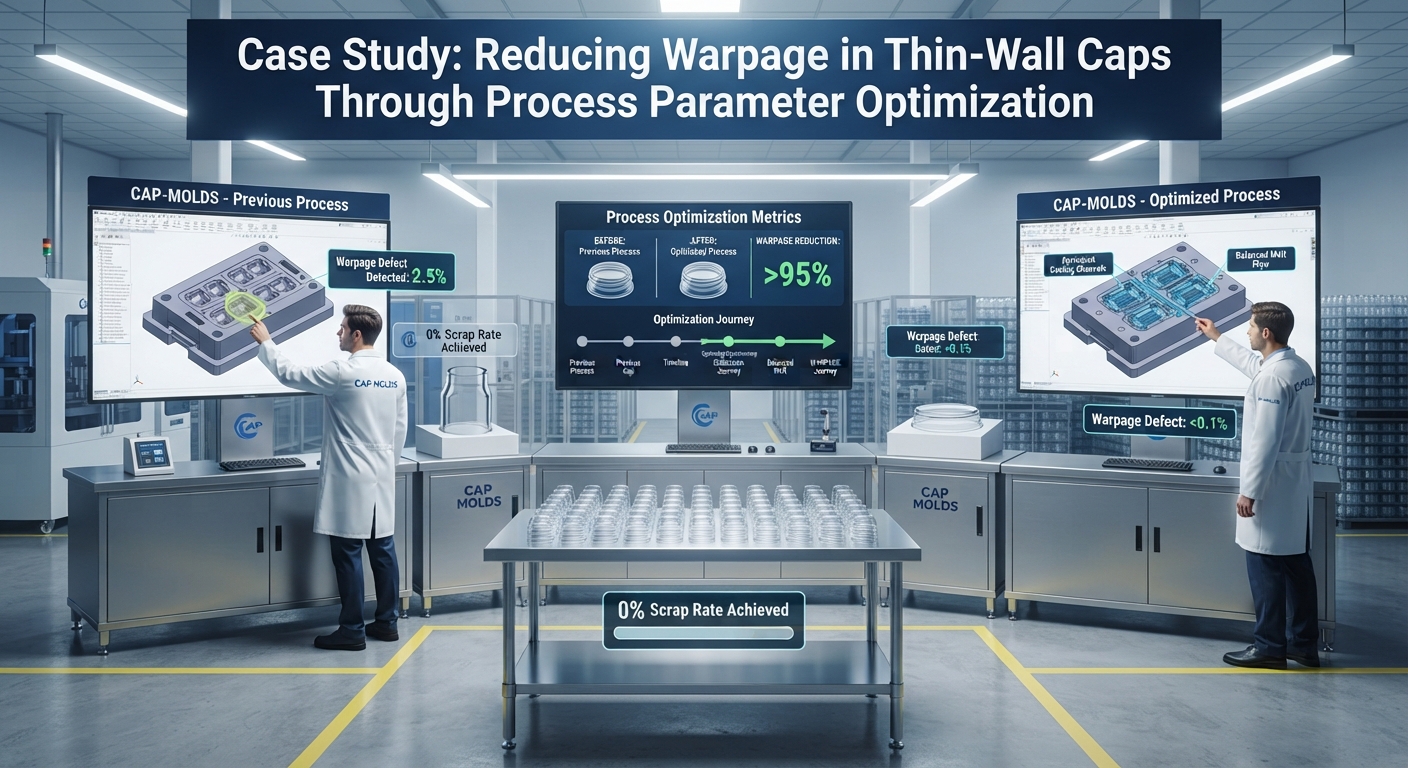
Case Study: Reducing Warpage in Thin-Wall Caps Through Process Parameter Optimization
In the high-speed realm of mass-volume plastic packaging, thin-wall cap manufacturing pushes injection molding technology to its absolute limits. As brand owners demand lighter closures to reduce material costs and environmental impact, wall thicknesses continue to shrink—often dropping below 0.5mm. However, extreme thinning introduces a severe manufacturing hazard: thermal residual stress, uneven volumetric shrinkage, and post-molding warpage.
As a leading Chinese engineering and manufacturing specialist in high-performance closure tooling, .cap-molds delivers advanced, turnkey mold solutions engineered for exceptional dimensional stability. In this technical case study, our engineering team details how we diagnosed and eliminated severe warpage and ovality defects in a high-cavity thin-wall cap production line through precise mold architecture and process parameter optimization.
1. Project Background and Initial Defect Analysis
A major international beverage packaging converter approached .cap-molds after experiencing unacceptable rejection rates on a newly scaled high-cavity thin-wall cap production line. The closures were suffering from severe dimensional distortion:
- Ovality and Skirt Distortion: Upon ejection, the circular cap skirts experienced asymmetric shrinkage, transforming into an elliptical shape that failed automated capping assembly lines.
- Top-Plate Warpage: Residual thermal stress caused the top dome of the caps to crown inward, compromising the internal sealing plug and causing leakage under pressure.
Initial troubleshooting on the molding shop floor by altering machine barrel temperatures and clamping tonnage yielded marginal improvements, proving that the root cause lay deeper within the thermal-mechanical interaction between the mold design and processing parameters.
2. Root Cause Identification: Thermal Imbalance and Cooling Inefficiencies
Using advanced CAE Moldflow simulation combined with physical coordinate measuring machine (CMM) scans of the distorted caps, the engineering team at .cap-molds pinpointed two primary failure drivers:
A. Asymmetric Heat Dissipation in High-Speed Cycles
Because thin-wall caps cycle in under 5 seconds, polymer melt is injected at high velocity and solidifies almost instantly. Due to restricted space in the core inserts, legacy cooling channels failed to extract heat uniformly from the thick thread sections versus the ultra-thin top panels, creating differential shrinkage gradients.
B. Excessive Injection Pressure and Molecular Orientation
To prevent short shots, the previous setup utilized excessively high injection speeds and packing pressures, locking high levels of anisotropic molecular orientation into the polymer chains. When ejected, uneven relaxation of these chains triggered severe directional warpage.
3. The .cap-molds Engineering Intervention & Optimization
To permanently solve the warpage crisis, .cap-molds deployed a comprehensive tooling retrofit and process optimization strategy:
- Conformal Cooling Integration: We redesigned the core inserts using 3D metal printing technology to incorporate conformal cooling channels that hugged the exact contour of the thin-wall cap, accelerating heat extraction by 35% and ensuring uniform thermal distribution.
- Beryllium Copper (BeCu) Inserts: High-conductivity BeCu inserts were embedded around the critical sealing and thread zones to instantly dissipate residual heat and stabilize volumetric shrinkage.
- Process Parameter Fine-Tuning: We optimized the injection profile by implementing a decoupled multi-stage velocity-to-pressure (V/P) switchover, lowering peak injection stress while maintaining complete, flash-free filling.
- Elite Material Selection: All core and cavity components were upgraded to vacuum-hardened Swedish S136 stainless steel (HRC 48–52), providing superior resistance to wear and ensuring long-term dimensional repeatability.
4. Results and Performance Metrics
Following the integration of the optimized mold architecture and calibrated process parameters by .cap-molds, the client's production line achieved immediate, quantifiable improvements:
| Performance Metric | Before Optimization | After .cap-molds Intervention |
|---|---|---|
| Cap Ovality / Warpage Rate | 8.5% rejection rate | < 0.2% (Virtually zero distortion) |
| Cycle Time | 5.8 seconds | 4.2 seconds (Increased throughput) |
| Weight Consistency Variance | ± 1.5% | ± 0.1% (Absolute uniformity) |
| Overall Equipment Effectiveness (OEE) | 71% | 96% |
Partner with .cap-molds for Expert Closure Solutions
Solving complex thin-wall warpage challenges requires a rigorous combination of advanced thermal engineering, precision mold design, and process optimization expertise. As a premier Chinese cap mold manufacturer, .cap-molds combines world-class CNC machining (Makino and Yasda centers) with deep closure industry specialization to deliver turnkey mold solutions that maximize your productivity and profitability.
Facing persistent warpage issues or looking to optimize your thin-wall cap production? Contact the engineering experts at .cap-molds today to request a comprehensive technical consultation and design review.
Keywords: reducing warpage in caps, thin-wall cap mold, bottle cap mold, cap mold design, .cap-molds, China cap mold manufacturer, injection molding warpage, closure tooling expert, conformal cooling mold, S136 mold steel, high speed cap production, process parameter optimization, plastic closure tooling, precision cap tooling