Case Study: Reducing Cap Weight by 15% Through Mold Flow Optimization and Advanced Cooling Design
Case Study: Reducing Cap Weight by 15% Through Mold Flow Optimization and Advanced Cooling Design
Published by cap-molds — Technical Case Study & Tooling Optimization Whitepaper
Executive Summary & Industry Background
In the high-volume beverage and packaging sectors, raw material cost accounts for over 60% to 70% of total closure production expenditure. As global consumer packaged goods (CPG) brands face escalating ESG compliance demands and rising resin costs, lightweighting plastic closures has become a top operational priority. However, reducing resin mass without compromising sealing performance, strip torque, or structural rigidity presents severe engineering hurdles.
When a leading beverage packaging manufacturer sought to lightweight their standard 28mm mineral water closures, they partnered with cap-molds. Through advanced DFM analysis, predictive Moldflow rheological simulation, and 3D metal-printed conformal cooling technology, our engineering team successfully reduced closure weight by 15% while cutting cycle times and maintaining 100% functional seal integrity.
1. The Lightweighting Challenge: Balancing Material Mass and Mechanical Rigidity
Shaving resin from a plastic cap alters flow length-to-thickness ($L/T$) ratios, narrows injection processing windows, and increases the risk of core pin deflection, sink marks, and out-of-roundness (ovality). The client’s baseline 28mm HDPE cap weighed 1.85 grams with a nominal wall thickness of 0.85mm. The target was to achieve a 1.57-gram final weight (a 15.1% reduction) with a thin-wall core profile down to 0.62mm.
Primary Engineering Risk Factors:
- Unbalanced Cavity Filling: High shear rates caused by thin walls can lead to polymer degradation, hesitations, and short shots across multi-cavity tools.
- Thermal Hotspots: Reduced wall stock alters heat extraction rates, causing differential shrinkage between the cap skirt, thread profiles, and top seal lip.
- Structural Distortion Under Torque: Excessive wall thinning can cause closure collapse during high-speed capping operations or thread stripping under torque loads.
2. Mold Flow Rheological Simulation & Gate Optimization
To eliminate trial-and-error tooling iterations, cap-molds utilized comprehensive 3D Moldflow analysis to evaluate shear rates, injection pressure drops, volumetric shrinkage, and air trap locations prior to steel cutting.
| Simulation Parameter | Baseline Design (1.85g) | cap-molds Optimized Design (1.57g) | Engineering Benefit |
|---|---|---|---|
| Wall Thickness (Skirt / Top) | 0.85 mm / 1.10 mm | 0.62 mm / 0.82 mm | 15.1% total resin volume reduction |
| Injection Pressure Drop | 42 MPa | 68 MPa (Balanced via optimized gate) | Prevents polymer shear degradation and stress concentration |
| Volumetric Shrinkage Variance | 2.8% | 0.9% (Uniform distribution) | Eliminates cap ovality and guarantees plug seal dimensional accuracy |
3. Thermal Engineering: Conformal Cooling & Beryllium Copper Integration
Thin-walled caps require rapid, uniform heat extraction to freeze the polymer matrix uniformly, preventing warpage and allowing ultra-fast mold opening. Traditional straight-drilled cooling channels leave localized hotspots around deep thread cores, extending cycle times.
To overcome this bottleneck, cap-molds re-engineered the core inserts using 3D Direct Metal Laser Sintering (DMLS) metal printing and conductive metallurgical alloys:
- 3D Conformal Cooling Channels: Spiral cooling paths contouring the internal thread geometry within 1.2mm of the molding surface ensure maximum turbulent fluid flow and heat absorption.
- Beryllium Copper (BeCu) Core Tips: High thermal conductivity BeCu inserts press-fitted at core apexes draw localized heat rapidly away from the delicate inner plug seal.
- Cycle Time Outcome: Conformal thermal management reduced the cooling phase from 2.8 seconds to 1.7 seconds, achieving an overall production cycle time under 4.2 seconds.
4. Precision Tooling Execution & Sub-Micron Component Interchangeability
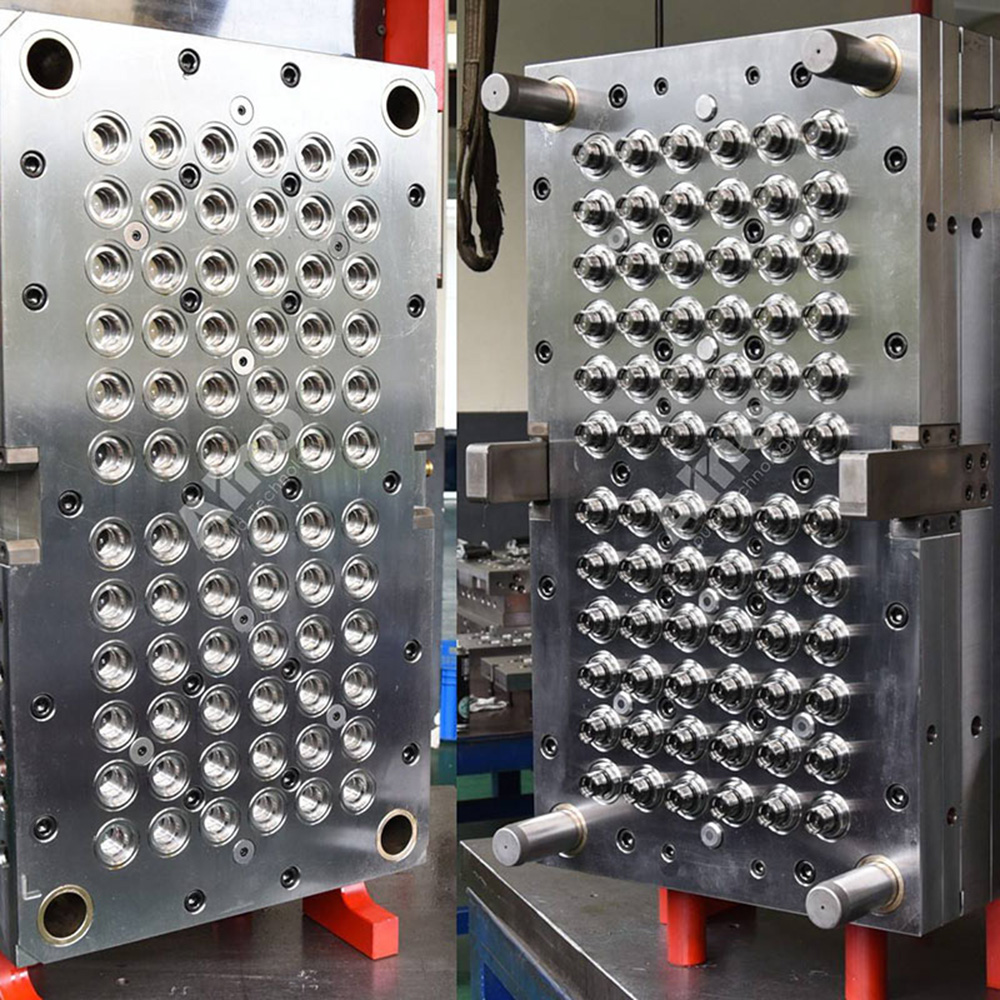
Injecting lightweighted HDPE closures under high injection velocities requires ultra-rigid tool structures to resist core deflection and flash. cap-molds manufactured the multi-cavity tool to sub-micron tolerances:
- Hardened Tool Steel Inserts: Cavity and core inserts were machined from ESR-grade S136 stainless steel, vacuum heat-treated to HRC 52–54 for superior wear resistance.
- Tapered Interlocks & Core Alignment: Precision dual-tapered guidance rings guarantee perfect concentricity between core and cavity, maintaining uniform wall thickness tolerances within ±0.003mm.
- 100% Plug-and-Play Interchangeability: Every core, cavity, and neck ring insert across all cavities is CNC-ground to exact dimensions, enabling direct spare parts replacement without manual fitting.
5. Quality Validation and Performance Results
Following in-house Factory Acceptance Testing (FAT) on high-speed injection molding equipment, the lightweighted closures underwent full performance verification:
- Pressure & Seal Integrity: Caps maintained zero-leakage performance under carbonated pressure testing exceeding 6.2 bar.
- Capping Torque & Drop Resistance: Thread profile integrity passed full application torque tests and 1.8-meter bottle drop tests without cracking or thread stripping.
- ROI & Material Savings: The 15% mass reduction saved the client over 140 metric tons of HDPE resin annually per production line, delivering full tooling ROI within 5 months of deployment.
Partner with cap-molds: Your Professional Closure Tooling Specialist
At cap-molds, we deliver complete, end-to-end bottle cap molding solutions engineered for high output, maximum material economy, and robust operational lifespans. From lightweight cap design and Moldflow rheological optimization to ultra-precision CNC manufacturing and 3D conformal cooling integration, our engineering teams empower global packaging converters to achieve peak profitability.