Best Steel Materials for Plastic Bottle Cap Mould Manufacturing: An Engineering Guide
In the high-precision world of injection molding, the longevity, cycle time, and quality of the final product depend entirely on one foundational decision: selecting the right core and cavity steel. For high-speed, multi-cavity plastic bottle cap production, this choice is even more critical. Caps for beverages, pharmaceuticals, and edible oils require absolute dimensional consistency, flawless sealing threads, and zero flash.
As a leading plastic bottle cap mould solutions expert, Shuanghao Mould leverages decades of manufacturing expertise to provide a deep technical analysis of the premium steel materials that drive high-efficiency cap production.
1. Why Steel Selection is Critical for Bottle Cap Moulds
Plastic bottle caps are typically mass-produced using HDPE or PP materials through high-speed injection molding or continuous compression molding. The mold faces unique engineering challenges:
- High-Frequency Wear: Fast cycle times (often under 5–8 seconds) cause severe mechanical friction on threads and sliders.
- Corrosive Outgassing: Certain plastics and color masterbatches release corrosive volatiles during high-temperature shearing.
- Extreme Clamping Pressure: Thin-walled cap designs require high injection pressure, demanding excellent compressive strength to prevent deformation.
- Thermal Fatigue: Continuous heating and rapid cooling cycles place heavy thermal stress on the core and cavity inserts.
2. Top Premium Steel Materials for Cap Mould Components
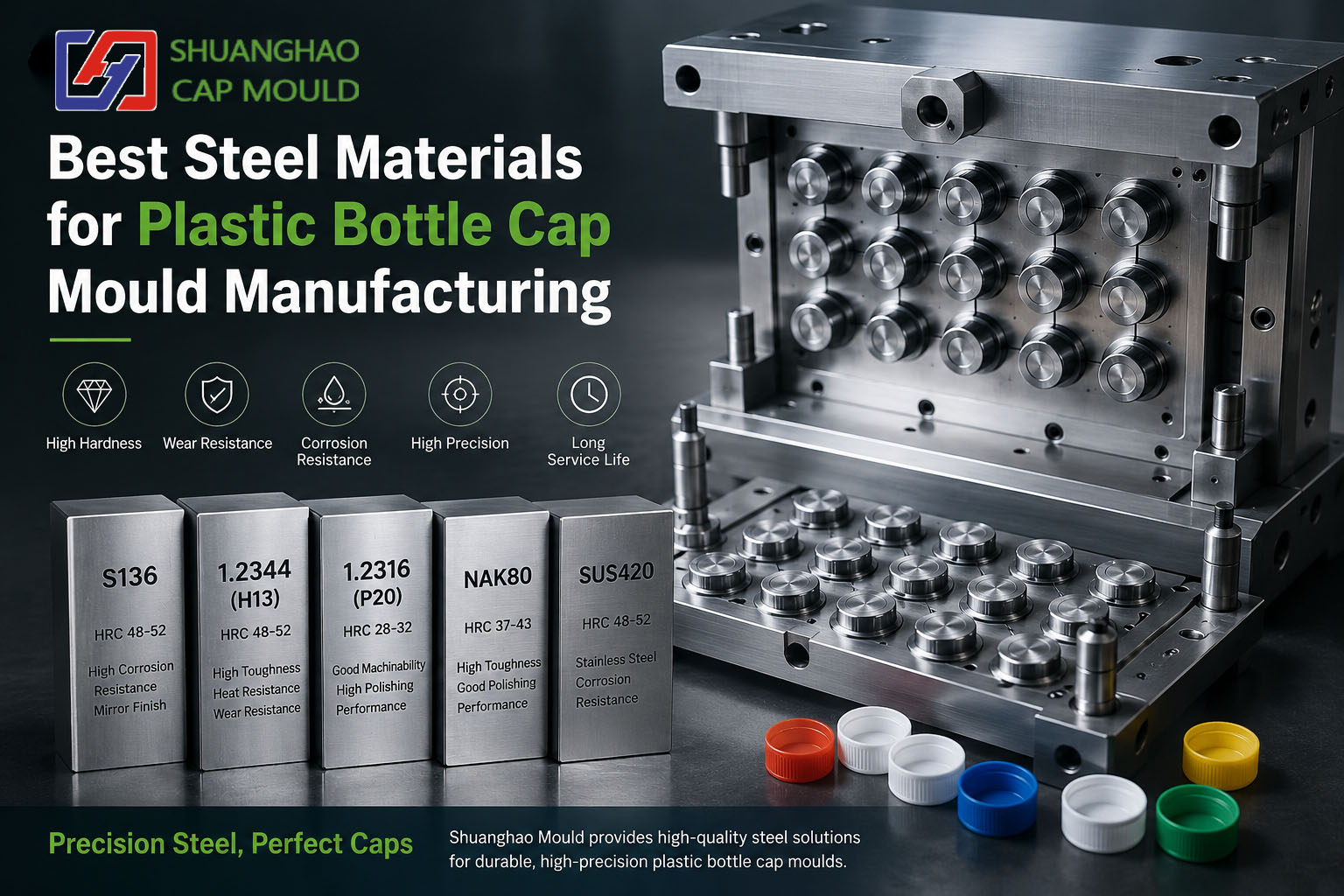
A professional plastic bottle cap mould utilizes a combination of different steel grades tailored to the specific functions of the core, cavity, neck ring, and mold base.
A. S136 (Sweden Uddeholm / European Standard) – The Corrosion & Mirror Finish Standard
S136 is a premium stainless tool steel with excellent corrosion resistance and exceptional polishability.
- Key Properties: High chromium content, superb wear resistance, and high dimensional stability after heat treatment.
- Best Used For: Mould cavities and core inserts for transparent caps, medical packaging, or production environments using corrosive additives.
- Shuanghao Expertise: We utilize vacuum-melted S136 through precise heat treatment to achieve a hardness of HRC 48–52, ensuring a mirror finish that prevents caps from sticking and minimizes ejection friction.
B. 2316 (German DIN Standard) – High Corrosion Resistance for Long Runs
DIN 1.2316 is a pre-hardened chrome-molybdenum stainless steel known for its superior anti-acid properties.
- Key Properties: Uniform hardness across large cross-sections and high resistance to chemical aggressive plastics.
- Best Used For: High-cavitation cap mold cavities and cooling channels where water scale or rust could reduce thermal transfer efficiency.
C. H13 / 1.2344 – Outstanding Thermal Fatigue & Toughness
H13 is a chromium-molybdenum hot-work tool steel widely respected for its mechanical toughness at elevated temperatures.
- Key Properties: High resistance to thermal shocking, excellent red hardness, and strong impact resistance.
- Best Used For: Slider blocks, lifters, and core components subjected to severe mechanical stress and rapid cycle variations.
D. DC53 / D2 – High Wear Resistance for Thread Profiles
When engineering the unscrewing mechanisms or neck rings for threaded bottle caps, mechanical abrasion is the primary enemy.
- Key Properties: Extreme hardness (HRC 60–62 after tempering) and superior fatigue strength.
- Best Used For: Thread inserts, cutting rings, and stripper plates.
E. Beryllium Copper Alloys (BeCu) – Advanced Thermal Management
While not a steel, no high-performance cap mould discussion is complete without Beryllium Copper.
- Key Properties: Thermal conductivity up to 3–4 times higher than tool steel.
- Best Used For: Core tips and gate areas where heat concentrates. Integrating BeCu inserts slashes cycle times by speeding up the solidification of the cap dome.
3. Comparative Matrix: Cap Mould Steel Selection
| Steel Grade | Optimal Hardness (HRC) | Wear Resistance | Corrosion Resistance | Polishability | Primary Application |
|---|---|---|---|---|---|
| S136 | 48 - 52 | High | Excellent | Mirror Polish | Cavity Inserts, Premium Caps |
| 1.2316 | 28 - 32 (Pre-hard) | Medium-High | Exceptional | Good | Corrosion-prone cooling components |
| H13 | 46 - 50 | High | Medium | Medium | Moving parts, sliders, lifters |
| DC53 | 60 - 62 | Extreme | Low | Low | Thread rings, cutting edges |
4. The Shuanghao Mould Manufacturing Edge
Choosing the correct steel grade is only half the battle; proper steel processing determines the ultimate lifecycle of the tool. At Shuanghao Mould, our manufacturing workflow guarantees peak material performance:
- Vacuum Heat Treatment: We prevent surface decarburization and internal stresses, ensuring uniform hardness from the core to the surface.
- Cryogenic Treatment: For ultra-high-precision multi-cavity flip-top or mineral water cap moulds, deep cryogenic processing is applied to maximize dimensional stability over millions of cycles.
- Optimized Cooling Layouts: We align premium steel inserts with 3D conformal cooling channels to unlock optimal thermal dissipation, directly shortening production cycles and preventing cap warping.
Whether you require a high-speed packaging solution, a 48-cavity water bottle cap mould, or an oil bottle cap tooling system, Shuanghao Mould delivers tailored, high-performance designs built to last.