AI Vision Systems in Cap Molding: Real-Time Defect Detection and Predictive Process Control
AI Vision Systems in Cap Molding: Real-Time Defect Detection and Predictive Process Control
An Engineering Analysis on Integrating High-Speed Computer Vision and Closed-Loop Control in High-Cavity Closure Injection Tooling
Executive Summary
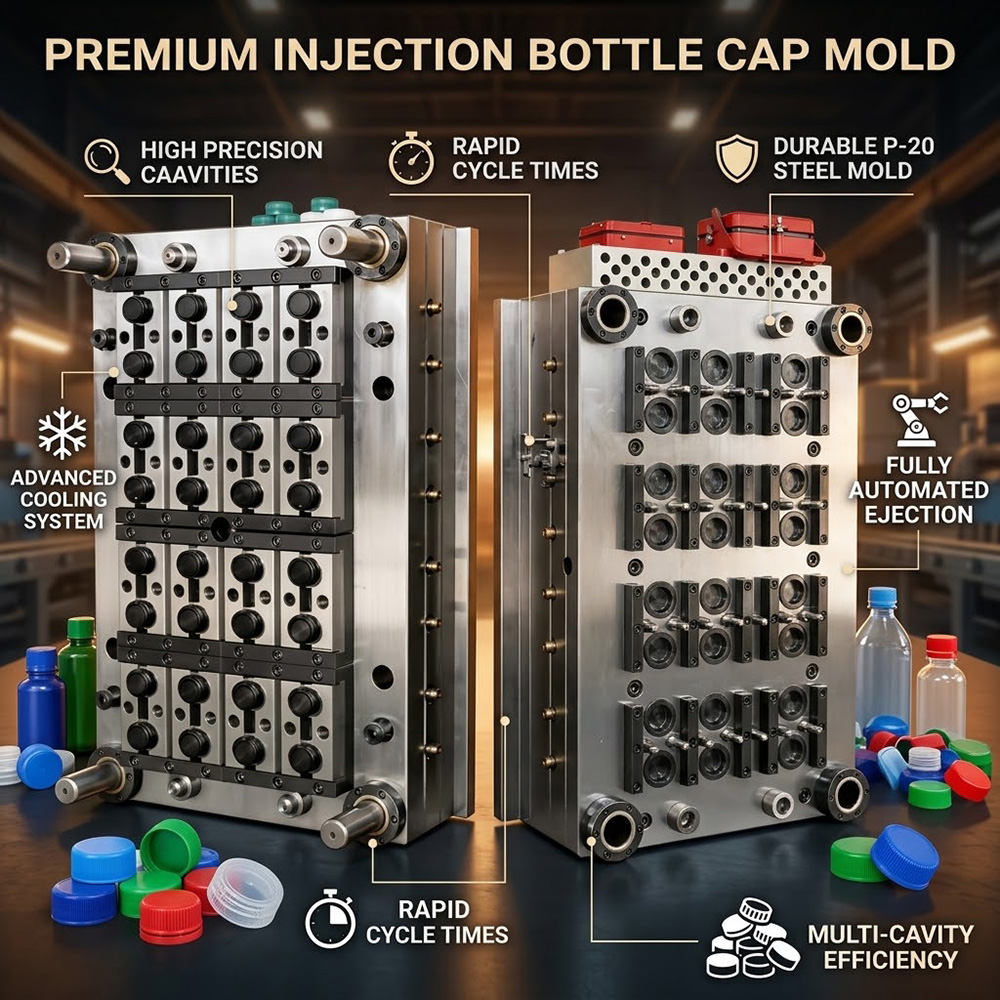
In high-cavity plastic closure manufacturing, traditional quality assurance relying on manual offline sampling or basic optical sensors fails to match the speed and precision of modern injection molding lines. With cycle times operating below 3.0 seconds across 48-, 72-, and 96-cavity configurations, even minor process drift can produce tens of thousands of defective caps within minutes. cap-molds integrates advanced machine vision algorithms directly into high-cavity cap tooling architectures to transition high-speed closure production from reactive inspection to real-time, predictive process prevention.
Micro-Defects in High-Speed Plastic Closure Production
Plastic packaging closures demand absolute dimensional tolerance and aesthetic integrity to guarantee hermetic seals, tamper evidence, and seamless high-speed capping line compatibility. Standard inspection methods encounter critical limitations when dealing with micro-scale defects:
- Tamper-Evident Band (TEB) Bridge Fractures: Micro-cracks or partial detachment in TEB bridges often occur during high-speed ejection, leading to line stoppages at beverage bottling facilities.
- Sealing Lip Flash and Short Shots: Incomplete cavity filling or thermal expansion deviations cause subtle sealing lip irregularities that compromise carbonation retention in CSD (Carbonated Soft Drink) applications.
- Internal Thread Distortion: Non-uniform cooling or improper core retraction leads to pitch variances in internal cap threads, triggering capping machine jamming.
- Ovality and Concentricity Drift: Asymmetrical shrinkage in multi-cavity tooling causes ovality, making closure application unreliable under automated torque settings.
Multi-Camera AI Vision Architecture and Optical Integration
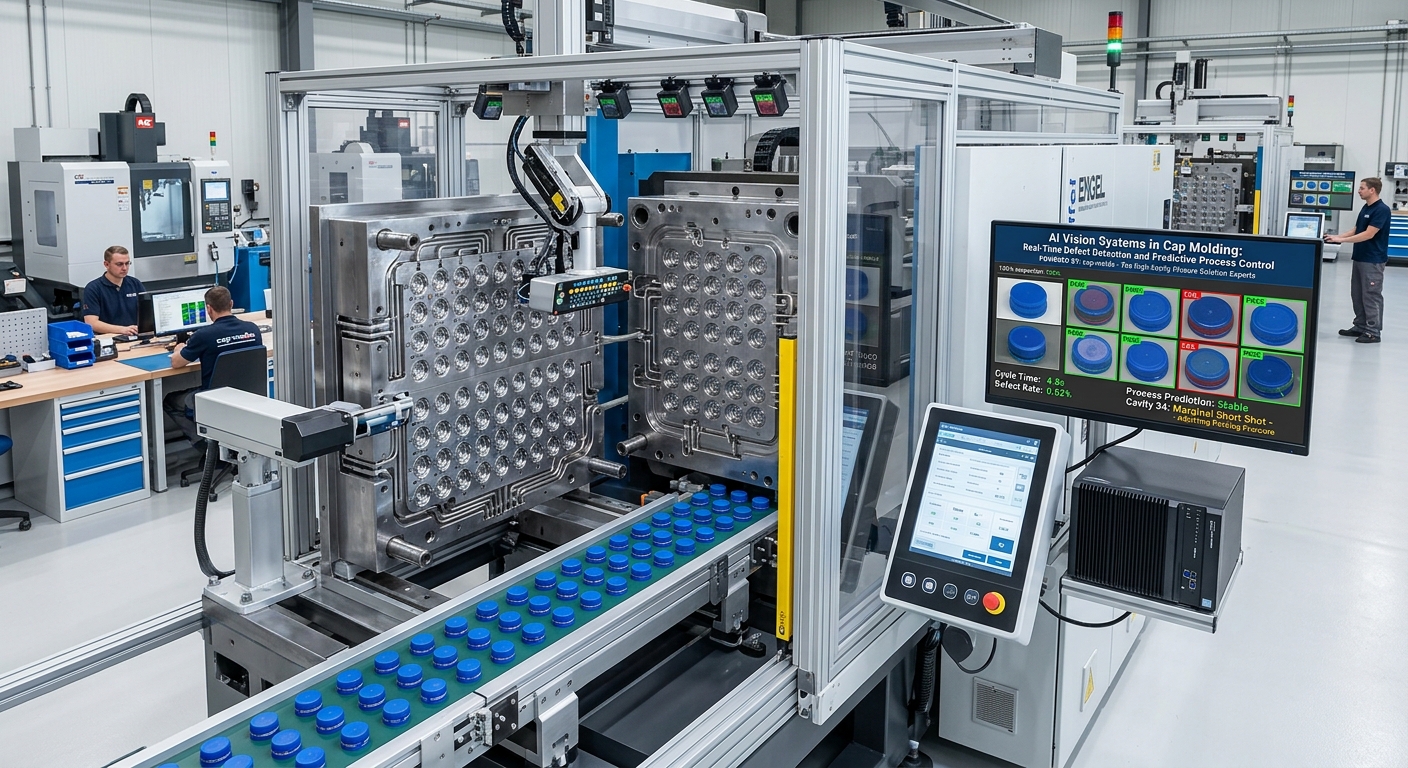
To capture micro-defects at production speeds exceeding 1,200 closures per minute, cap-molds deploys an integrated optical array combined with edge-computing neural networks.
1. Optical Hardware and Illumination Spectrum
The vision system incorporates ultra-high-resolution CMOS sensors (up to 12 MP) combined with multi-angle directional LED lighting and polarization filters:
- Top-Down Dome Lighting: Eliminates specular glare on glossy polypropylene (PP) and high-density polyethylene (HDPE) surfaces to accurately evaluate gate vestige height and top-surface planarity.
- 360-Degree Internal Thread Imaging: Multi-mirror prism optical configurations capture the entire 360° inner thread profile and inner seal (plug seal/linerless seal) in a single frame pass.
- Backlit TEB Transillumination: High-intensity stroboscopic backlighting highlights individual bridge integrity, immediately spotting sub-millimeter stress fractures or thin-wall flash.
2. Deep Learning Algorithms vs. Rule-Based Vision
Conventional rule-based vision systems suffer from high false-rejection rates due to ambient light variations or normal resin color fluctuations. The deep learning inference engine utilized by cap-molds trains on convolutional neural networks (CNNs) trained on millions of annotated closure images:
- Self-Learning Feature Extraction: Differentiates acceptable cosmetic flow lines from functional cracks or flash defects.
- Real-Time Inference Speed: Processed locally via tensor processing units (TPUs) at edge nodes, completing defect classification in less than 12 milliseconds per cap.
From Quality Inspection to Closed-Loop Predictive Process Control
The core innovation of the cap-molds solution lies in connecting AI vision analytics back to the injection molding machine (IMM) and hot runner temperature controllers.
Closed-Loop Integration Methodology
- Defect Detection and Spatial Mapping: When an anomaly (e.g., flash on Cavity 32) is detected, the vision system tags the exact cavity location using inline RFID tracking or encoder feedback.
- Process Drift Quantification: The system computes trend data across consecutive cycles. If Cavity 32 exhibits dimensional shrinkage over 5 cycles, the system identifies thermal drift in that specific hot runner tip.
- Autonomous Parameter Adjustment: Through OPC UA industrial communication protocols, the AI controller adjusts the specific hot runner nozzle temperature zone or modifies cavity-specific holding pressure profiles before defective caps are produced.
Quantifiable Performance Improvements and ROI Analysis
Implementing inline AI vision systems alongside precision cap-molds tooling yields significant operational and financial benefits across high-volume packaging plants:
| Performance Metric | Conventional Offline QA | cap-molds AI Vision Integration | Operational Impact |
|---|---|---|---|
| Defect Detection Rate | < 92% (Sampling) | 99.98% (100% Inline) | Zero non-conforming closures reach customer lines |
| Scrap Rate (%) | 1.8% - 2.5% | < 0.3% | Up to 85% reduction in wasted PP/HDPE resin |
| Unplanned Downtime | 4.2 Hours/Week | < 0.5 Hours/Week | Prevents mold damage caused by stuck caps or double stamping |
| False Rejection Rate | 3.5% | < 0.1% | Eliminates unnecessary rejection of good product |
Frequently Asked Questions (FAQ)
How does the AI vision system adapt to color changeovers in cap production?
The deep learning model utilizes color-agnostic feature extraction models. During color changes, the system auto-calibrates lighting intensity and edge contrast within 30 seconds, maintaining defect detection accuracy without requiring manual mask reconfiguration.
Can AI vision systems prevent mold damage in high-cavity closure production?
Yes. By inspecting the mold face during the open stroke (Mold Protection Vision), the system verifies that 100% of caps have successfully ejected before the mold closes. If a cap remains stuck on a core pin, the IMM closing cycle is aborted in milliseconds, preventing catastrophic mold damage.
How does cap-molds ensure compatibility between vision hardware and hot runner systems?
As a specialized cap mold manufacturer, cap-molds designs closure tooling with native mounting points, fiber-optic cable routing, and internal sensor ports built into the mold plate architecture, ensuring seamless plug-and-play integration with major IMM brands.